In the name of God
The Islamic Women’s Institute of Iran was founded through the initiative and dedication of a socially engaged and justice-oriented woman, Azam Taleghani. She was a figure deeply committed to social justice, the advancement of women’s status, and the empowerment of marginalized groups.
During her imprisonment under the Pahlavi regime, Taleghani came to understand that women’s progress and independence require awareness, education, and self-reliance. After her release in 1979, coinciding with the victory of the Revolution, she briefly assumed responsibility for the Women’s Organization, which had been active before the Revolution. During this short period, she travelled to various cities and worked with local women, helping create opportunities for raising awareness and supporting women’s social participation.
Over time, due to differences in vision, she stepped away from that institution and chose to establish an independent, community-based organization rooted in human and social values. Drawing on her extensive national networks, she initiated educational–cultural camps, empowerment programs, and various classes in cultural, economic, social, and religious fields.
Despite legal and bureaucratic obstacles, persistent efforts eventually led to obtaining official authorization, and the Islamic Women’s Institute was formally established in 1983.
Performance of the Islamic Women’s Institute of Iran: Past to Present
In 1999 (2000 CE), the Institute achieved Special Consultative Status from the United Nations Economic and Social Council (ECOSOC). Its more than four decades of activity can be broadly divided into three phases:
Objectives of the Institute
Scops of Activity
A) National Activities
Training and empowering women and families in income-generation, entrepreneurship, legal and social counseling, and personal skills.
Organizing workshops and seminars, including:
• Seminar on the role of women in poverty alleviation (1995)
• Three-day workshop in Soltanabad on the 12 critical Beijing themes (2000)
• Workshops on research methods (2000), negotiation (2009), social harms and human rights (2004)
• Training programs on addiction prevention for instructors (2003)
• Computer courses, sewing courses with UNICEF cooperation, life-skills training, and family-law education
Field-based projects:
• Field research on implementing the Beijing themes in Soltanabad (2000–2001)
• Houbara bird conservation project in Fars Province through rural women’s empowerment (2003–2004) and establishment of Nakhl-Neshan Cooperative for date-processing and women’s employment
Participation in national conferences and events:
• World Conference Against Racism (2000)
• Meetings on drafting the statute for the NGO Empowerment Council (2000)
• Conferences on economics, human rights, social harms, divorce, and women’s rights
B) Regional Participation
• Baghdad Regional Conference (1980)
• Asian Regional Conference, New Delhi, India (1981)
C) International Participation
• UN World Conference on Women, Nairobi (1981)
• World Conference on Human Rights, Vienna (1993), and Johannesburg (1998)
• UN World Conference on Women, Beijing (1995), Beijing+5 in New York (2000)
• Beijing+10, New York (2005)
• Conference on Women and Poverty, Denmark
• Participation at the Universities of Tokyo and Kyoto on women’s rights in Islam
• Attendance at the 58th Commission on the Status of Women, New York (2014)
• Participation in the UN Human Rights Commission, Geneva (2000–2002)
• Oral statement delivered at the UN Human Rights Council, Geneva (2014)
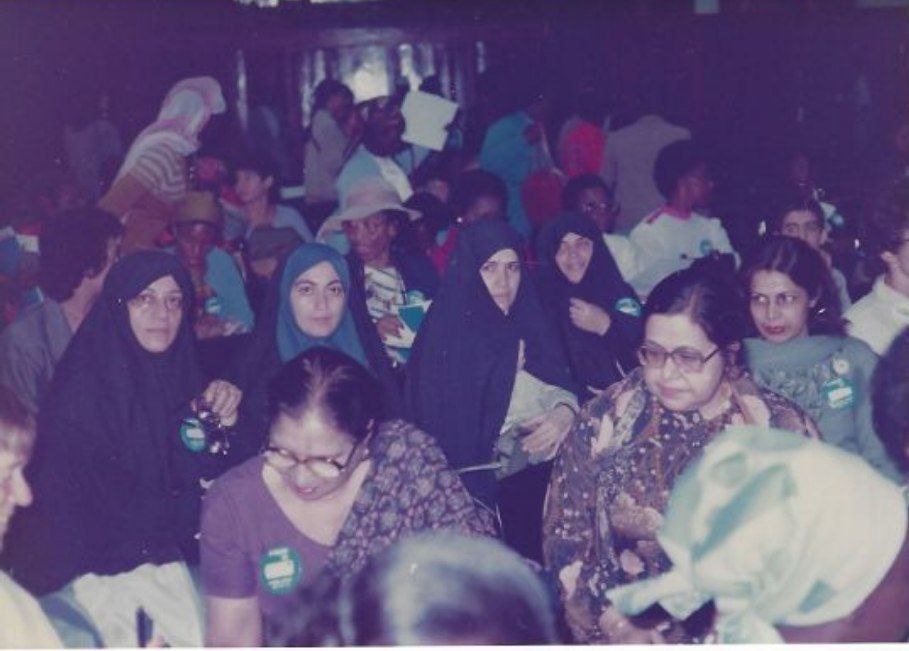
After the passing of the esteemed Azam Taleghani, the Institute’s activities were paused for a period. However, in 2024, through the dedication of her family and the support of committed advocates of women’s rights and social justice, the Institute resumed its work and entered a renewed phase of activity and growth.